


Buying a yacht

What to look for in a sea trial: a practical buyer checklist

Leon Bekkers, founder of Bekkers YachtsBy Leon Bekkers, founder
What to look for in a sea trial: a practical buyer checklist, Bekkers Yachts

A sea trial is where a yacht proves itself. Use it to check three things: how the boat behaves at speed and at rest, how it feels to live with on board, and how well it is built. Plan for at least half a day, bring a written checklist, and test the yacht in the way you will actually use it. On an AZUR 45HT that means cruising at 30+ knots, but also idling into a harbour and sitting in the cabin with the engines running.

Before the sea trial

Agree what you want to test

Write down how you plan to use the yacht. Day trips with friends, long weekends with family, fast runs between islands, or shallow anchorages. Each use asks something different of the boat. Share this with the yard beforehand so the trial can be set up to match.

Ask for the right configuration

Engines, trim and load change the result. If you are choosing between engine options, ask which version you will be trialling. The AZUR 45HT is available with three Volvo Penta IPS packages, from IPS 600 to IPS 800, and the difference matters for top speed and fuel use. Ask the yard which configuration is available for the trial and how it compares to the one you are considering.

Check the conditions

Flat water flatters every hull. If you can, choose a day with some wind or chop, or ask to run through wake. A hard chine hull like the AZUR 45 is designed to handle this, and you will want to feel it yourself.

Bring the right people

Bring the person who will helm most often. An independent surveyor helps if you are less experienced, but take the helm yourself.

On the water

Noise

Noise is one of the most telling indicators of build quality and engine installation. Check it in three places: at the helm, in the cockpit or lounge, and in the cabin. Test at idle, at cruising speed and at full throttle.

  • Can you hold a normal conversation at the helm at cruising speed?
  • Is there vibration in the deck, the wheel or the furniture?
  • Are there rattles from cupboards, hatches or hardtop panels?
  • Does sound from the engine room travel into the cabin?

A low noise level is part of the AZUR 45HT specification, and a trial is the right moment to check any builder's claim.

Handling

Take the helm for a meaningful part of the trial, not just a few minutes.

  • Accelerate from idle to cruise and note how the bow rises and settles.
  • Make tight turns at speed in both directions. The boat should stay predictable and not slide or lean uncomfortably.
  • Cross your own wake and any passing wake. Listen for slamming and feel how the hull lands.
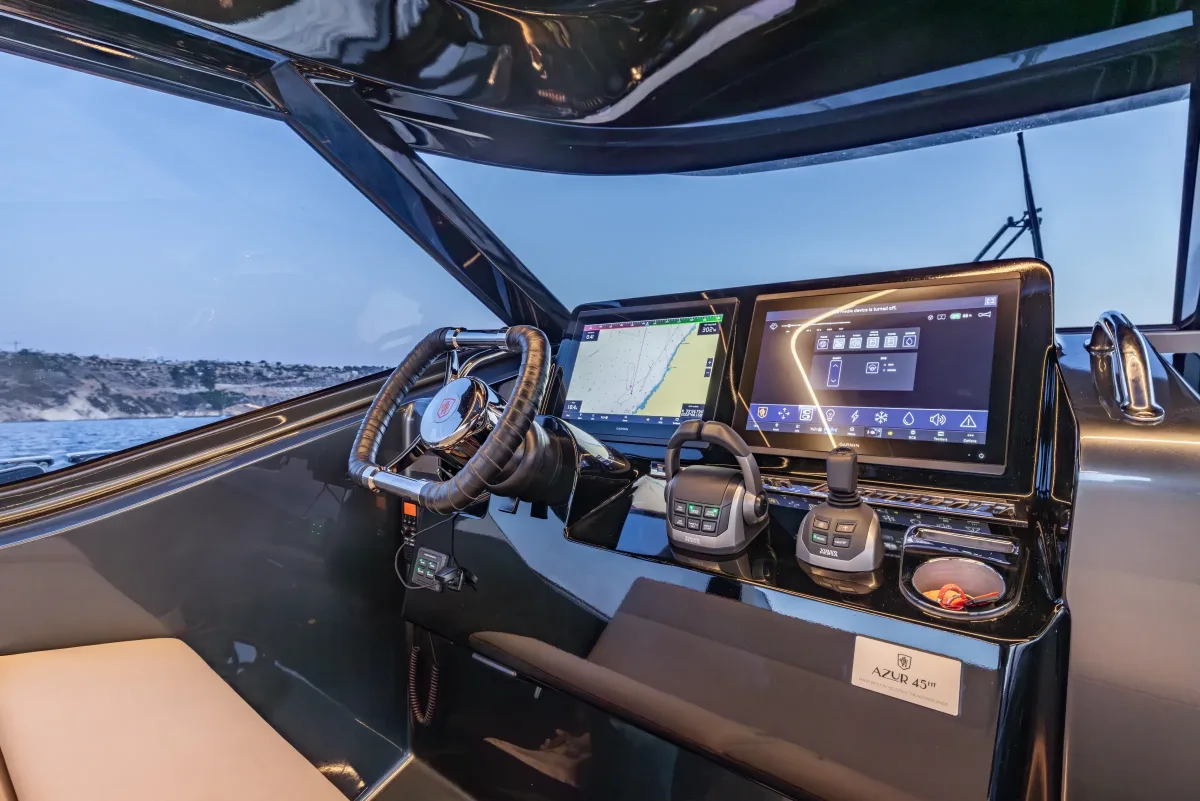
  • Test low speed manoeuvring: docking, turning on the spot and holding position. With pod drives such as Volvo Penta IPS, joystick control makes this very different from a conventional setup.
  • Check visibility from the helm, seated and standing, especially forward over the bow when on the plane.

Headroom and living space

Spend time inside while underway and at anchor. Stand up in the cabin and the bathroom. The AZUR 45HT and Carib 64HT both offer 2 m headroom, so tall guests should be able to move without stooping. Sit on the berths, open the cupboards, try the shower and toilet. On a weekender, ask yourself whether you would happily spend two nights here.

Systems

Ask the crew to show the main systems working. On a well-equipped day yacht this can include the electric sun awning, the electric boarding and swim ladder, the outdoor galley, the outdoor shower and the lighting. Check that everything runs smoothly, quietly and without strain.

Finish details: what to look at closely

Build quality shows in the details. Bring a torch and take your time, ideally when the boat is back at the dock.

AreaWhat to check
WeldsOn an aluminium yacht, look along hull joins, rails and hardtop supports. Seams should be smooth and invisible under the paint.
PaintLook along the hull in low light. Check for ripples, orange peel texture, dust inclusions and colour consistency between panels.
Stainless steelCheck rails, cleats, fittings and the wheel for even polish, tight joins and no sharp edges.
JoineryOpen and close every door and drawer. Gaps should be even and latches should close firmly.
UpholsteryCheck stitching, seams and how leather and fabric meet hard surfaces.
DeckLook at the edges of teak or Flexiteek and where the deck meets fittings.
GlazingCheck seals around windows, skylights and hatches for neat, even lines.

Welds and paint deserve special attention on an aluminium yacht. Fairing and painting a metal hull well takes many hours of handwork. This is where builders differ most, and where Bekkers draws on its background in stainless steel work for leading Dutch superyacht yards. Motor Boat & Yachting reported no visible weld marks on the AZUR 45. Use that as a benchmark for any boat you trial.

After the sea trial

Write it down the same day

Impressions fade quickly. Note what you liked, what surprised you and what you would change. Include specific numbers: speeds, engine revs, any noise readings.

Ask follow-up questions

Use your notes to ask the builder clear questions. Typical topics are the expected fuel use at your preferred cruising speed, maintenance intervals, warranty, delivery and aftersales. For running costs and engine choice, see our guides on yacht running costs and Volvo Penta IPS.

Discuss your configuration

A custom yacht can be adjusted to your findings. If you want more speed, a different layout or a specific colour, this is the moment to discuss it. Bekkers offers paint to sample in any colour combination and interior materials on request.

Where to take a sea trial with Bekkers Yachts

Sea trials are available at the yard in Heusden, on the river Maas in the south of the Netherlands. You can test the yacht on the water where it was built. Request a trial through the sea trial page and the yard will reply personally within one working day.

Frequently asked questions

How long should a sea trial take?

Plan for at least half a day. That gives time for a briefing, a proper run on the water in different conditions, and a close look at the finish afterwards. Rushing a trial is a common mistake.

Should I take the helm myself during a sea trial?

Yes. You will learn far more by helming than by watching. Ask to try acceleration, tight turns, crossing wake and low speed docking, so you understand how the yacht behaves in real use.

What is the most important thing to check on an aluminium yacht?

Look closely at the welds and the paint. Seams should be invisible and the hull should look smooth along its length in low light. This shows how much handwork has gone into fairing and finishing.

Can I do a sea trial with Bekkers Yachts outside the Netherlands?

Yes. Sea trials take place at the yard in Heusden. Ask the yard which yacht and configuration is available at each location.

Does a sea trial commit me to buying?

A sea trial is part of making an informed decision. Terms for trials can differ between builders and boats, so ask the yard to explain how a trial is arranged before you book.
Request a sea trial at the yard in Heusden

The yard replies personally within one working day. Call +31 (0)416 768 038 or email welcome@bekkersyachts.com.

Get in touch
Buying a yacht

What to look for in a sea trial: a practical buyer checklist

Leon Bekkers, founder of Bekkers YachtsBy Leon Bekkers, founder
What to look for in a sea trial: a practical buyer checklist, Bekkers Yachts

A sea trial is where a yacht proves itself. Use it to check three things: how the boat behaves at speed and at rest, how it feels to live with on board, and how well it is built. Plan for at least half a day, bring a written checklist, and test the yacht in the way you will actually use it. On an AZUR 45HT that means cruising at 30+ knots, but also idling into a harbour and sitting in the cabin with the engines running.

Before the sea trial

Agree what you want to test

Write down how you plan to use the yacht. Day trips with friends, long weekends with family, fast runs between islands, or shallow anchorages. Each use asks something different of the boat. Share this with the yard beforehand so the trial can be set up to match.

Ask for the right configuration

Engines, trim and load change the result. If you are choosing between engine options, ask which version you will be trialling. The AZUR 45HT is available with three Volvo Penta IPS packages, from IPS 600 to IPS 800, and the difference matters for top speed and fuel use. Ask the yard which configuration is available for the trial and how it compares to the one you are considering.

Check the conditions

Flat water flatters every hull. If you can, choose a day with some wind or chop, or ask to run through wake. A hard chine hull like the AZUR 45 is designed to handle this, and you will want to feel it yourself.

Bring the right people

Bring the person who will helm most often. An independent surveyor helps if you are less experienced, but take the helm yourself.

On the water

Noise

Noise is one of the most telling indicators of build quality and engine installation. Check it in three places: at the helm, in the cockpit or lounge, and in the cabin. Test at idle, at cruising speed and at full throttle.

  • Can you hold a normal conversation at the helm at cruising speed?
  • Is there vibration in the deck, the wheel or the furniture?
  • Are there rattles from cupboards, hatches or hardtop panels?
  • Does sound from the engine room travel into the cabin?

A low noise level is part of the AZUR 45HT specification, and a trial is the right moment to check any builder's claim.

Handling

Take the helm for a meaningful part of the trial, not just a few minutes.

  • Accelerate from idle to cruise and note how the bow rises and settles.
  • Make tight turns at speed in both directions. The boat should stay predictable and not slide or lean uncomfortably.
  • Cross your own wake and any passing wake. Listen for slamming and feel how the hull lands.
  • Test low speed manoeuvring: docking, turning on the spot and holding position. With pod drives such as Volvo Penta IPS, joystick control makes this very different from a conventional setup.
  • Check visibility from the helm, seated and standing, especially forward over the bow when on the plane.

Headroom and living space

Spend time inside while underway and at anchor. Stand up in the cabin and the bathroom. The AZUR 45HT and Carib 64HT both offer 2 m headroom, so tall guests should be able to move without stooping. Sit on the berths, open the cupboards, try the shower and toilet. On a weekender, ask yourself whether you would happily spend two nights here.

Systems

Ask the crew to show the main systems working. On a well-equipped day yacht this can include the electric sun awning, the electric boarding and swim ladder, the outdoor galley, the outdoor shower and the lighting. Check that everything runs smoothly, quietly and without strain.

Finish details: what to look at closely

Build quality shows in the details. Bring a torch and take your time, ideally when the boat is back at the dock.

AreaWhat to check
WeldsOn an aluminium yacht, look along hull joins, rails and hardtop supports. Seams should be smooth and invisible under the paint.
PaintLook along the hull in low light. Check for ripples, orange peel texture, dust inclusions and colour consistency between panels.
Stainless steelCheck rails, cleats, fittings and the wheel for even polish, tight joins and no sharp edges.
JoineryOpen and close every door and drawer. Gaps should be even and latches should close firmly.
UpholsteryCheck stitching, seams and how leather and fabric meet hard surfaces.
DeckLook at the edges of teak or Flexiteek and where the deck meets fittings.
GlazingCheck seals around windows, skylights and hatches for neat, even lines.

Welds and paint deserve special attention on an aluminium yacht. Fairing and painting a metal hull well takes many hours of handwork. This is where builders differ most, and where Bekkers draws on its background in stainless steel work for leading Dutch superyacht yards. Motor Boat & Yachting reported no visible weld marks on the AZUR 45. Use that as a benchmark for any boat you trial.

After the sea trial

Write it down the same day

Impressions fade quickly. Note what you liked, what surprised you and what you would change. Include specific numbers: speeds, engine revs, any noise readings.

Ask follow-up questions

Use your notes to ask the builder clear questions. Typical topics are the expected fuel use at your preferred cruising speed, maintenance intervals, warranty, delivery and aftersales. For running costs and engine choice, see our guides on yacht running costs and Volvo Penta IPS.

Discuss your configuration

A custom yacht can be adjusted to your findings. If you want more speed, a different layout or a specific colour, this is the moment to discuss it. Bekkers offers paint to sample in any colour combination and interior materials on request.

Where to take a sea trial with Bekkers Yachts

Sea trials are available at the yard in Heusden, on the river Maas in the south of the Netherlands. You can test the yacht on the water where it was built. Request a trial through the sea trial page and the yard will reply personally within one working day.

Frequently asked questions

How long should a sea trial take?

Plan for at least half a day. That gives time for a briefing, a proper run on the water in different conditions, and a close look at the finish afterwards. Rushing a trial is a common mistake.

Should I take the helm myself during a sea trial?

Yes. You will learn far more by helming than by watching. Ask to try acceleration, tight turns, crossing wake and low speed docking, so you understand how the yacht behaves in real use.

What is the most important thing to check on an aluminium yacht?

Look closely at the welds and the paint. Seams should be invisible and the hull should look smooth along its length in low light. This shows how much handwork has gone into fairing and finishing.

Can I do a sea trial with Bekkers Yachts outside the Netherlands?

Yes. Sea trials take place at the yard in Heusden. Ask the yard which yacht and configuration is available at each location.

Does a sea trial commit me to buying?

A sea trial is part of making an informed decision. Terms for trials can differ between builders and boats, so ask the yard to explain how a trial is arranged before you book.

Request a sea trial at the yard in Heusden

The yard replies personally within one working day. Call +31 (0)416 768 038 or email welcome@bekkersyachts.com.

We use functional cookies to make this site work and, with your consent, analytics cookies to improve it. Read our cookie policy.